
The most common advice about OpenRouter alternatives is to find another service with more models and cheaper tokens. That's often the wrong move. If your application depends on a particular model, you might need a direct inference provider, not another marketplace. If security review is blocking deployment, a larger catalog won't solve your problem.
OpenRouter isn't always the right gateway, but replacing it only helps when you know which responsibility you're moving. Model access, provider routing, inference hosting, and production governance are different jobs. A service can handle one well without replacing the others.
For a maker launching an AI product, the immediate constraint might be consolidated billing across text and media generation. A platform engineer might care more about credential management, request logs, or controlling where prompts travel. An interactive application might need faster generation on a supported open-weight model rather than access to every proprietary model family.
The best OpenRouter alternatives therefore fall into distinct categories:
- Managed multi-provider gateways and marketplaces, including UberLLM, Vercel AI Gateway, Cloudflare AI Gateway, and Requesty.
- Production control planes and self-hosted gateways, including Portkey and LiteLLM.
- Direct inference hosts, including Together AI, Fireworks AI, and Groq.
These aren't interchangeable purchases. Start with what your application needs to replace, then rule out tools whose architecture doesn't fit.
#Table of Contents
- 1. UberLLM
- 2. Vercel AI Gateway
- 3. Cloudflare AI Gateway
- 4. Requesty
- 5. Portkey
- 6. LiteLLM
- 7. Together AI
- 8. Fireworks AI
- 9. Groq
- How the main OpenRouter alternatives compare on access, pricing, compatibility, and fit
- Matching the Gateway to Your Stack and Risk Profile
#1. UberLLM

UberLLM is a marketplace replacement, not merely a proxy around provider accounts you already manage. UberLLM connects API customers with third-party model providers and sellers offering unused AI capacity, consolidating access through compatible interfaces and a prepaid balance.
Its useful distinction is the breadth of workflows behind that arrangement. Text and coding models sit alongside image generation, video, speech, music, and sound effects. Model families listed in its catalog include Claude, Gemini, DeepSeek, FLUX, Kling, and Veo, so it's relevant to products that would otherwise maintain separate integrations for chat and media.
For supported integrations, OpenAI-compatible and Anthropic-compatible interfaces let developers retain familiar SDK patterns while changing credentials, endpoints, and model identifiers. That reduces integration work, although API compatibility doesn't guarantee identical parameter support or response behavior.
#What the Marketplace Changes
UberLLM says its routing selects the cheapest healthy seller for the requested model and moves requests when a seller becomes slow or unavailable. That can simplify seller selection, but you should still test what happens after streaming begins or a media task has already been accepted.
Its workflow features matter as much as routing:
- Streaming responses support interactive text applications.
- Asynchronous tasks, polling, and webhooks support media jobs that don't finish within a normal request cycle.
- A playground lets you compare outputs and parameters before integrating.
- Scoped, revocable keys help separate application access and revoke compromised credentials.
Billing uses prepaid credit, and UberLLM states that unsuccessful requests or generations aren't charged. Credit-purchase fees still belong in your effective-cost calculation, even when there's no separate request fee.
I'd shortlist it for a small team building a multimodal product that wants fewer integrations and consolidated funding. Before committing, verify seller eligibility, model provenance, retention terms, and how completed tasks remain retrievable during an incident.
Wrong choice: A regulated application that requires every inference request to run through a named, contractually approved provider in a fixed region.
#2. Vercel AI Gateway
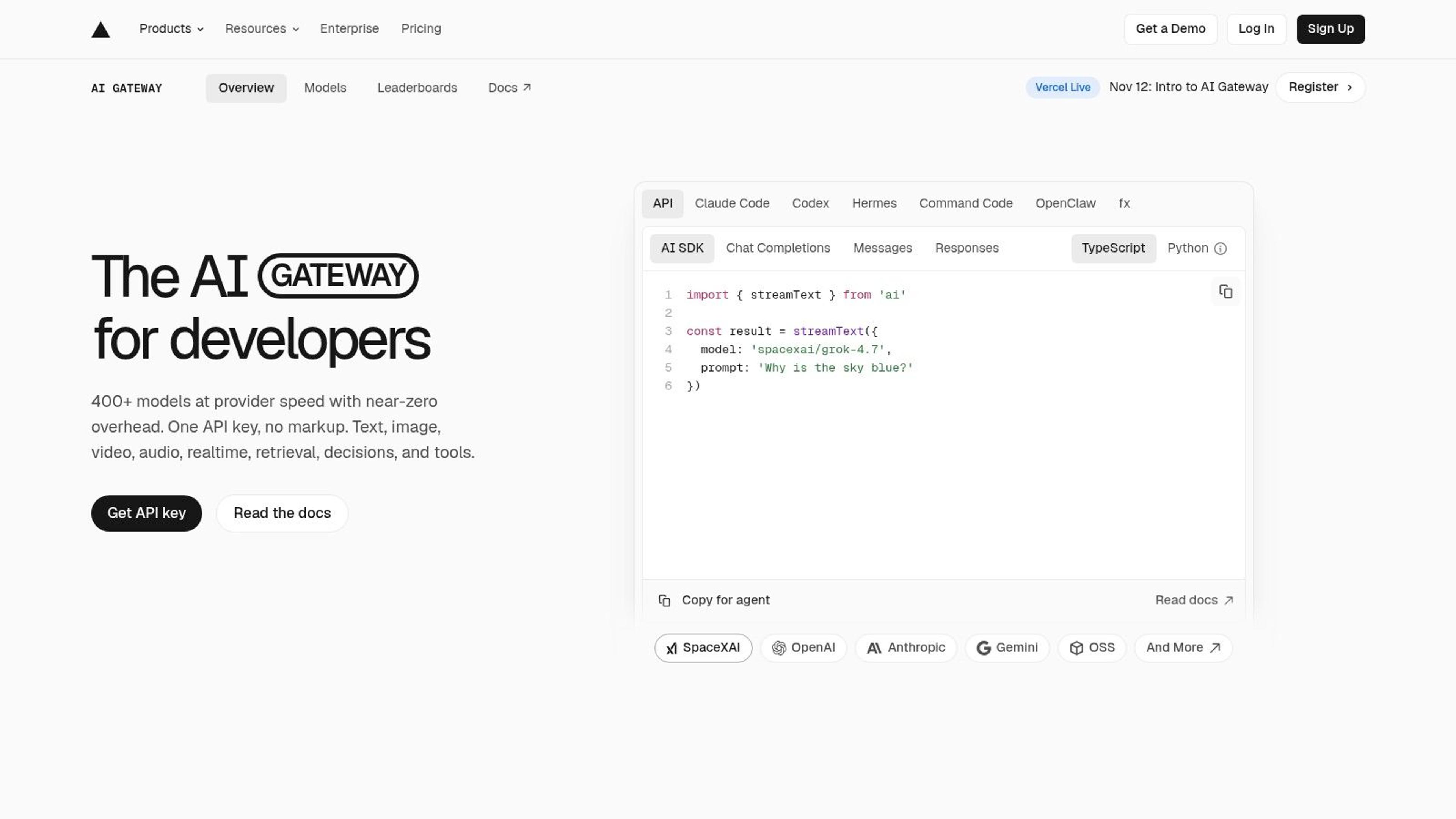
If your application already uses Vercel's AI SDK, Vercel AI Gateway deserves an early pilot. Its main advantage is reducing the integration distance between application code, model selection, billing, and request visibility.
Vercel AI Gateway provides a managed endpoint for models from multiple providers, with provider fallbacks and support for bringing your own provider keys. Rather than introducing another operational platform, you can manage model access alongside a development stack your team already understands.
#Convenience Versus Portability
The strongest case isn't catalog size. It's the ability to change models, inspect usage, and manage provider failures without building those capabilities into every application route.
That convenience still needs boundaries:
- Keep model mappings in configuration, rather than scattering provider-specific identifiers across components.
- Test SDK features explicitly, especially structured outputs, tool calls, streaming, and cancellation.
- Separate gateway charges from inference charges, and compare the complete bill rather than a headline about token markup.
Our AI tools directory can help you discover adjacent products, but discovery shouldn't substitute for a compatibility test against your actual application.
The trade-off is organizational coupling. A gateway that fits your existing Vercel workflow can be efficient; adopting that workflow solely to obtain routing may add unnecessary migration work. Also check how usage visibility maps to your own customers, since an application-level total won't necessarily answer tenant-level billing questions.
Wrong choice: A platform team standardizing a self-hosted gateway across applications that must remain independent of Vercel's operational ecosystem.
#3. Cloudflare AI Gateway
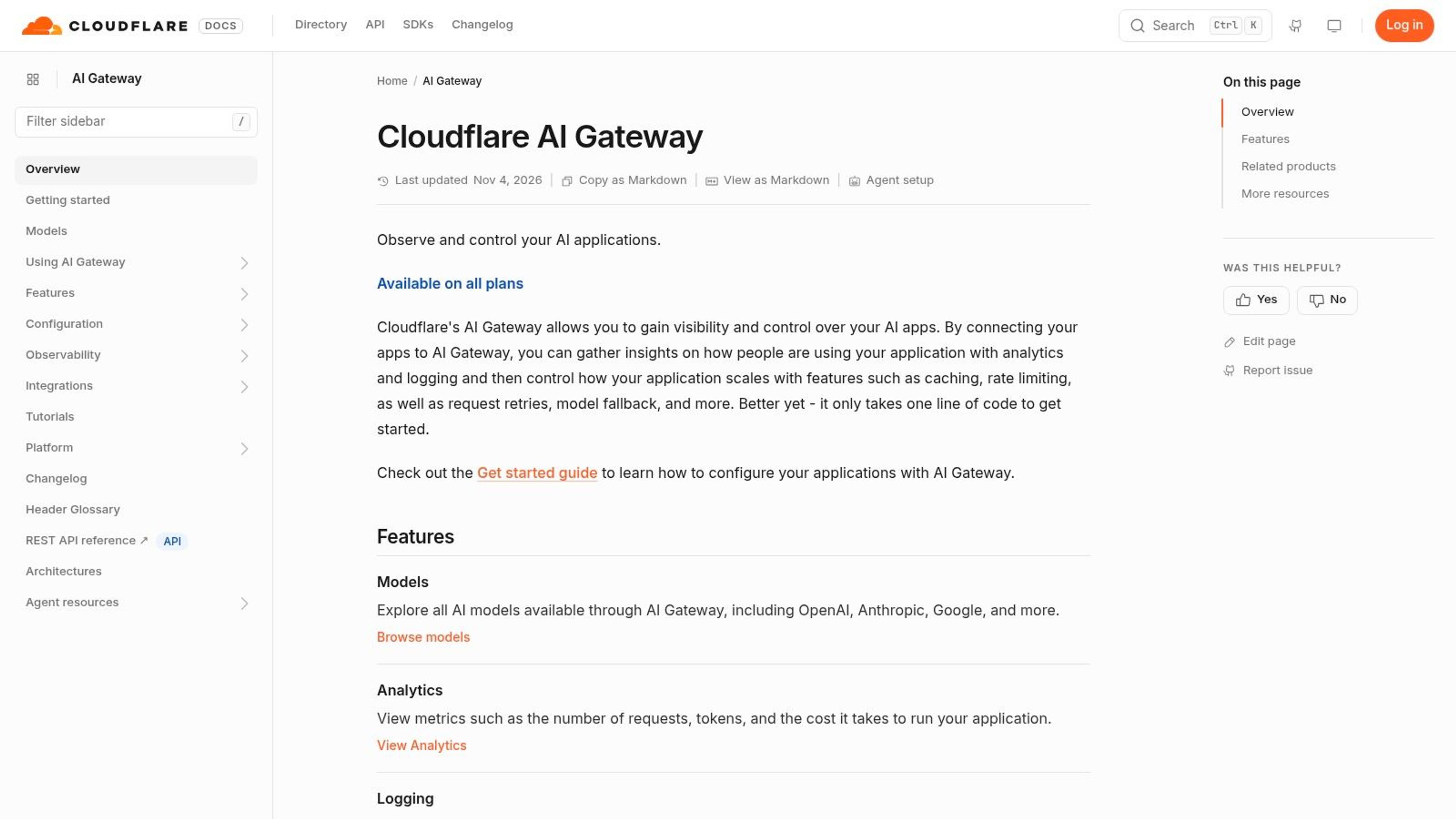
Cloudflare AI Gateway is most compelling when you want controls around existing inference traffic. You don't necessarily need to replace your model provider to benefit from logging, rate limiting, caching, and fallback policies.
Cloudflare's AI Gateway documentation describes a common interface for supported third-party providers and Cloudflare-hosted models. For a team already operating on Cloudflare, that can make gateway adoption less disruptive than introducing a separate hosting and monitoring stack.
Consider a support assistant that repeatedly answers questions from the same documentation. Gateway caching may reduce repeated inference, while rate limits can stop a malfunctioning client from consuming your budget. Neither feature removes the need to design application-level authorization and tenant isolation.
Practical rule: Don't enable shared response caching until you understand exactly which request fields identify the user, tenant, permissions, and document version.
#Compatibility Needs a Real Test
An OpenAI-compatible interface is a starting point, not proof that every endpoint or provider feature passes through unchanged. Check the current compatibility path for the API you use, then test streaming, errors, tool arguments, and usage reporting.
The cost model also needs careful reading. Gateway capabilities, upstream inference, and logging exports are separate concerns. A low-cost monitoring layer doesn't make the underlying model free, and exporting verbose request logs can introduce another operating expense.
Wrong choice: A team that needs an unsupported provider-specific endpoint and can't accept translation, feature gaps, or changes to its request format.
#4. Requesty
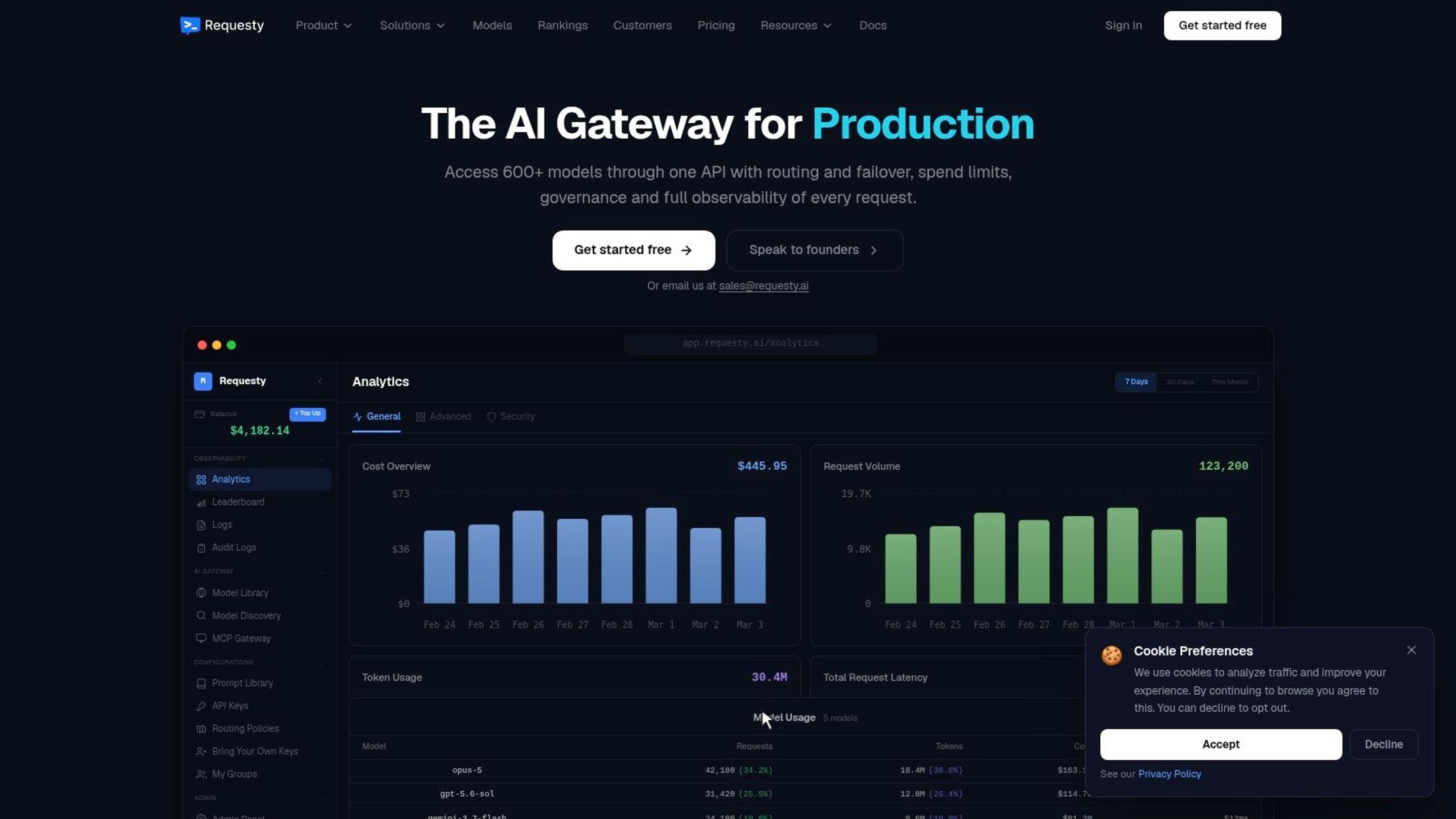
A European gateway endpoint isn't the same thing as European inference. That distinction matters when evaluating Requesty, a hosted multi-model gateway with routing, caching, fallbacks, spend tracking, and EU data-residency options.
Requesty fits the conventional managed-router role. Applications using an OpenAI client can adapt their base URL and credentials, then configure model selection and routing without operating a proxy themselves.
The spend controls earn their keep when several features or developers share the same model access. Attribution still depends on how you label requests and separate credentials, though: a shared key makes per-team costs hard to reconstruct after the fact. If you want a dedicated view of that spend, our AICost listing is a starting point for comparing cost-tracking tools.
#Follow the Entire Data Path
Evaluate residency against regional routing, retention defaults, subprocessors, deletion controls, and contractual guarantees. Privacy-policy wording alone won't tell you where a prompt ran.
Apply that checklist to Requesty:
- Gateway processing: Establish where requests, metadata, and cached responses are handled.
- Model processing: Confirm the inference region of the model route you selected.
- Failure handling: Determine whether a fallback can leave the approved geography.
That last check is the one that bites. If the primary route times out and the fallback sends a French customer's prompt to a model hosted outside your approved region, the request succeeded and the residency commitment didn't.
Requesty's hosted model removes proxy maintenance. It doesn't remove your job of pinning approved routes. Compare gateway markup and upstream charges using your actual model mix, and treat free access as an evaluation environment rather than evidence of production capacity.
Wrong choice: A workload requiring fully on-premises operation, or a residency guarantee your chosen model and fallback routes can't satisfy contractually.
#5. Portkey
Portkey replaces more of the production control plane than a basic model marketplace does. Its appeal increases when the hard questions concern failed agent runs, prompt changes, policy enforcement, and tracing requests across services.
Portkey combines gateway routing with retries, load balancing, fallbacks, observability, prompt management, and guardrails. It offers hosted operation alongside an open-source gateway option, making deployment architecture part of the selection rather than an afterthought.
For a production agent, a successful HTTP response tells you very little. You need to inspect which prompt version ran, which model handled the request, what tools it attempted to call, and whether a fallback changed the behavior. Those are control-plane problems.
#Buy Controls You'll Actually Operate
Portkey makes more sense when someone owns the policies behind its features:
- Retries need limits, so upstream failures don't create request storms.
- Logs need redaction and retention rules, especially when prompts contain customer information.
- Guardrails need evaluation, including false positives that block legitimate requests.
Our Arceris AI Security Gateway listing is relevant if security enforcement is your primary buying criterion rather than general routing.
The downside is configuration overhead. Prompt management, tracing, and governance can justify a platform, but they can also duplicate systems you already run. Confirm which capabilities belong to the hosted service, the self-hosted gateway, and enterprise deployment options before designing around them.
Wrong choice: A small application with a stable model choice that only needs straightforward inference access and has no owner for a separate governance platform.
#6. LiteLLM
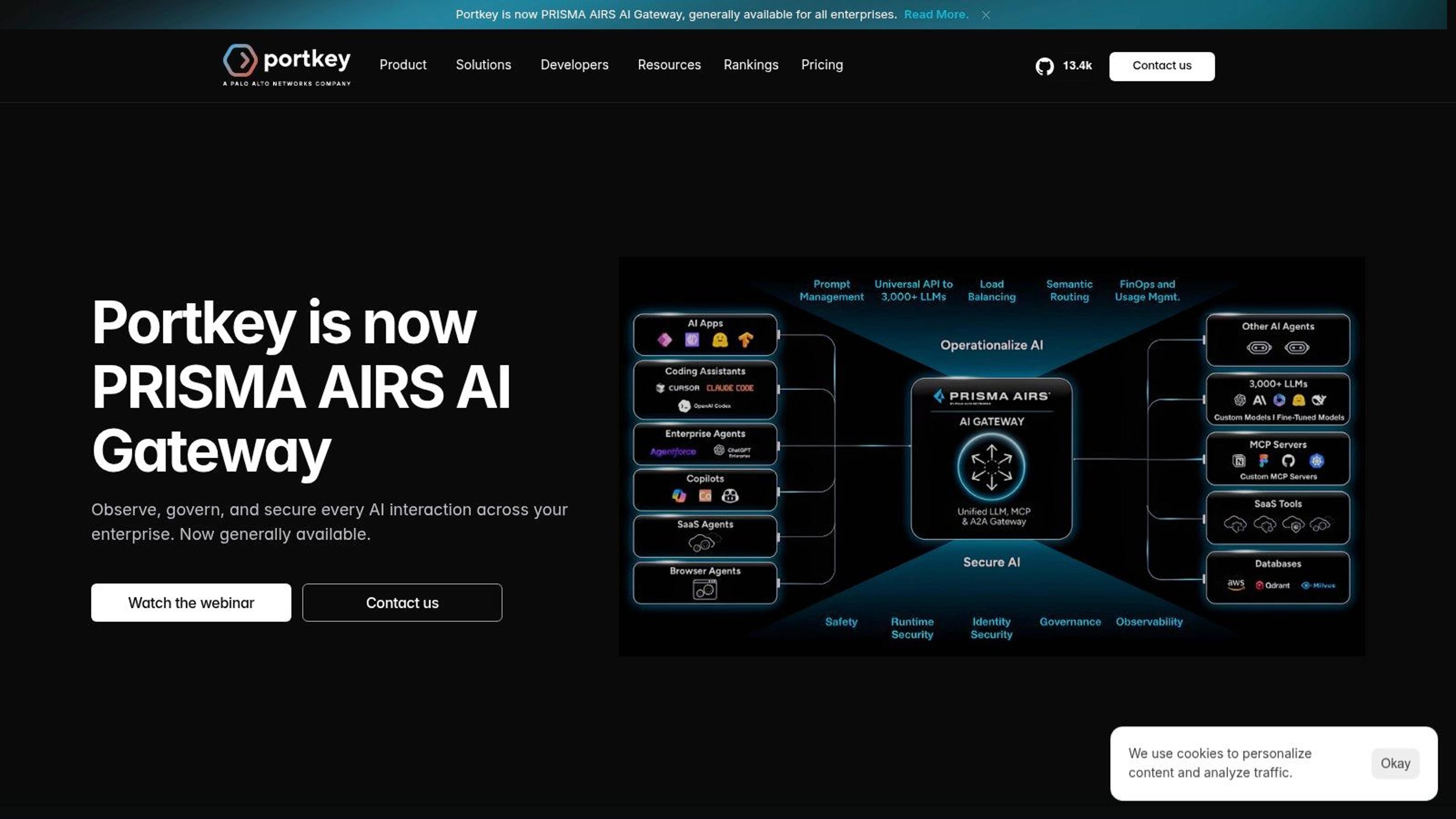
With LiteLLM, you operate the gateway. That changes both the value proposition and the failure modes: provider credentials, deployment configuration, scaling, and availability become your team's responsibility.
LiteLLM offers an open-source proxy with a common API, routing, virtual keys, budgets, rate limits, and spend tracking. AI Multiple's provider comparison identifies support for more than 100 providers, making it a relevant option when portability and self-hosting matter more than marketplace billing.
The practical use case is an internal model-access service. Application teams receive virtual keys, while a platform team manages upstream credentials, approved models, budgets, and fallback policy centrally.
#Control Includes Maintenance
Self-hosting removes a mandatory hosted gateway dependency, not the cost of running a reliable service. You still need deployment automation, secret rotation, health checks, monitoring, and a safe upgrade process.
Running LiteLLM in your own region controls the proxy's location. It doesn't automatically control where an upstream provider performs inference.
Test provider adapters before upgrading, especially when applications depend on structured outputs or tool calling. Keep a known-good configuration available for rollback, and avoid making the gateway's database or rate-limit backend an unexamined dependency.
I'd choose LiteLLM when a team already has infrastructure ownership and wants an internal access layer across projects. I wouldn't choose it merely to avoid a visible gateway fee while ignoring engineering time.
Wrong choice: A solo maker who needs managed access immediately and can't maintain an always-on proxy, its dependencies, and incident response.
#7. Together AI
If your application has settled on an open-weight model available from Together, another multi-provider gateway may be unnecessary. Together AI replaces the inference path, not the neutral routing layer.
Together AI offers hosted inference through an OpenAI-compatible API, with serverless access and dedicated or provisioned-capacity options. You avoid operating model-serving infrastructure while taking a direct dependency on Together's catalog and capacity.
That trade-off can be sensible for document extraction, summarization, or classification when evaluation has already narrowed your model choice. It's less useful when frequent switching between unrelated proprietary providers is part of your product.
#Price the Completed Workload
KDnuggets' provider comparison recommends evaluating effective cost with retries and failed requests, alongside representative latency and reliability testing. That's more useful than treating a token-price comparison as a universal cost ranking.
For a Together pilot, compare:
- Serverless behavior: Check burst handling, rate limits, and latency during your expected traffic pattern.
- Capacity commitments: Consider dedicated options only after measuring sustained demand.
- Output acceptance: Count valid, usable results rather than requests that merely returned successfully.
A cheaper generation that fails your extraction schema can cost more once you include validation, retries, and manual review. Keep a separate fallback path if an upstream incident would otherwise stop your application.
Wrong choice: A product promising interchangeable access to Claude, Gemini, and other proprietary model families through a neutral provider marketplace.
#8. Fireworks AI
Fireworks AI is worth considering when model serving is becoming a deployment decision. It combines hosted inference with fine-tuning and dedicated deployment options rather than trying to be a neutral gateway across every provider.
Fireworks AI supports serverless inference for its model catalog, fine-tuning for selected models, and GPU-based deployments for dedicated workloads. The useful progression is from validating a model through an API to deciding whether a more controlled serving arrangement fits sustained demand.
Say you're building a domain-specific extraction product. Start by testing whether a supported model produces valid outputs from your documents. Fine-tuning becomes relevant only after you've separated model limitations from weak prompts, missing context, and inconsistent evaluation examples.
#Separate Model Quality From Serving Quality
A deployment can serve tokens quickly while producing unusable answers. Conversely, a model that passes offline evaluation can still miss your application's latency budget under concurrent traffic.
- Evaluate task quality first, using held-out examples and explicit acceptance criteria.
- Test the serving path separately, including concurrency, streaming, timeouts, and cancellation.
- Choose deployment capacity last, once you understand utilization and operational requirements.
Serverless access limits initial infrastructure work. Dedicated deployments introduce capacity planning, and fine-tuned models add versioning and rollback responsibilities that a generic API integration doesn't have.
Check the live catalog for the exact base model, fine-tuning support, and serving options you need. Don't assume every model supports every deployment path.
Wrong choice: A team whose main requirement is consolidated billing and neutral fallback across unrelated proprietary model providers.
#9. Groq
For an interactive agent, waiting for generated output can dominate the user experience. Groq is a direct-provider candidate when inference speed on supported models matters more than catalog breadth.
Groq provides API access to models running on its inference infrastructure, with developer access tiers, documented model limits, and billing controls. It doesn't replace OpenRouter's broad provider marketplace; it replaces a particular model-serving route.
DeepInfra's inference-platform comparison reported approximately 297 output tokens per second for Groq in its tested comparison, but didn't test OpenRouter's throughput or time to first token. That finding supports testing Groq, not declaring it faster for every application or model.
#Measure the Whole Interaction
Generation speed is only part of an agent's response time. Retrieval, tool execution, model deliberation, and network travel can dominate before or between generated messages.
Latency advice: Measure from the user action to the first useful result, not just from the first generated token to the last.
Test the exact supported model and account tier you intend to use. A prototype with isolated requests won't reveal how rate limits behave when several users start sessions together.
Also verify tool-call correctness and structured-output reliability. Faster invalid arguments still leave your application with a failed workflow, and retrying them can erase the speed advantage.
Wrong choice: An application tied to a model Groq doesn't host, or one whose main bottleneck is external tools rather than inference.
#How the main OpenRouter alternatives compare on access, pricing, compatibility, and fit
The table sorts the alternatives by what they replace: neutral multi-provider gateways, single-provider inference hosts, and a self-hosted control plane. Read the Best For column as a ruling-out tool: if the fit described doesn't match your workload, that option is the wrong choice regardless of its feature list.
| Item | Model Coverage | Pricing Model | API Compatibility | Best For |
|---|---|---|---|---|
| UberLLM | Text, image, video, music, and speech models from multiple providers | Prepaid balance; provider charges with no request fee | OpenAI- and Anthropic-compatible | Multimodal access, marketplace pricing, and automatic seller failover |
| Vercel AI Gateway | Broad multi-provider catalog | Provider list prices; free starter credits | Unified gateway; suited to Vercel AI SDK | Teams already building with Vercel |
| Cloudflare AI Gateway | Cloudflare-hosted and third-party models | Core gateway features free; provider inference costs apply | OpenAI-compatible for supported providers | Cloudflare users seeking gateway controls and monitoring |
| Requesty | Large catalog of models from multiple providers | Free tier for free models; usage-based markup on provider charges | OpenAI client compatible via base URL | Managed routing with budgets, fallbacks, and EU data residency |
| Portkey | Models across providers | Free prototyping plan; production and enterprise options | Universal API | Production teams needing routing, observability, and governance |
| LiteLLM | Wide multi-provider support through one proxy | Open-source self-hosting; infrastructure costs; paid enterprise features | OpenAI-compatible | Teams wanting a controllable, self-hosted internal gateway |
| Together AI | Together-hosted open-weight models | Per-token serverless billing; dedicated options available | OpenAI-compatible | Workloads centered on Together's open-weight models |
| Fireworks AI | Fireworks-hosted models | Token-based serverless usage or GPU deployments | API-based inference | Teams seeking hosted inference, fine-tuning, or dedicated capacity |
| Groq | Models supported on Groq infrastructure | Free and pay-as-you-go developer tiers | Direct API for supported models | Applications prioritizing fast inference on supported models |
Two columns carry the most decision weight. API Compatibility determines switching cost: an OpenAI-compatible endpoint usually means a base URL change, while a universal or direct API may require adapter work. Pricing Model determines billing risk: prepaid balances and per-token billing expose you to provider price changes, while self-hosting trades those charges for infrastructure and maintenance costs you control.
#Matching the Gateway to Your Stack and Risk Profile
Choose the constraint before choosing the vendor. Neutral access, inference cost, speed, self-hosting, and residency lead to different shortlists, even when every candidate accepts a familiar request format.
For managed multi-provider access, evaluate UberLLM, Vercel AI Gateway, Cloudflare AI Gateway, and Requesty against the exact models and modalities you use. UberLLM is relevant to marketplace purchasing across text and media; Vercel and Cloudflare make sense when their existing development or infrastructure workflows reduce operational work. Requesty belongs on the shortlist when hosted routing and regional options are central requirements.
For production controls, compare Portkey with a self-hosted LiteLLM deployment. Portkey fits teams buying observability and governance alongside routing. LiteLLM fits teams prepared to own deployment and provider relationships themselves. Neither choice removes the need to define budgets, redact sensitive logs, or test failure handling.
#Build the Pilot Around Failure
If your workload centers on supported open-weight models, test Together AI, Fireworks AI, and Groq directly. Don't pay for architectural breadth your application doesn't use, but don't discard provider diversity without considering the operational consequences.
A useful pilot should exercise more than successful chat responses:
- Replay representative prompts, including long contexts, tool calls, structured outputs, and rejected inputs.
- Measure user-visible latency, including time to first token, completion time, and slow-tail behavior.
- Trigger controlled failures, such as unavailable routes, exhausted limits, and interrupted streams.
- Validate fallback semantics, including model quality, context limits, tool behavior, and final cost.
For media workflows, include accepted-but-unfinished tasks, duplicate webhook delivery, and recovery after a worker restart. For agents, verify that retries don't repeat an external action such as sending an email or creating an order.
Keep model identifiers and endpoint mappings in configuration so migration and rollback don't require application rewrites. Before moving production traffic, verify current catalogs, pricing, account limits, retention terms, and endpoint details directly with each provider.
A gateway's region doesn't establish the entire request's residency. Trace the path through logging, caching, inference, and fallbacks, then match that path to contractual requirements.
Pick the candidates that match your primary constraint and run your real workload through them before migrating. Record accepted-output cost, user-visible latency, and recovery behavior, then move traffic gradually with a tested rollback path. Once your product is ready for users, publish a free launch on Better Launch to give it a permanent product page and introduce it to indie founders and early adopters.